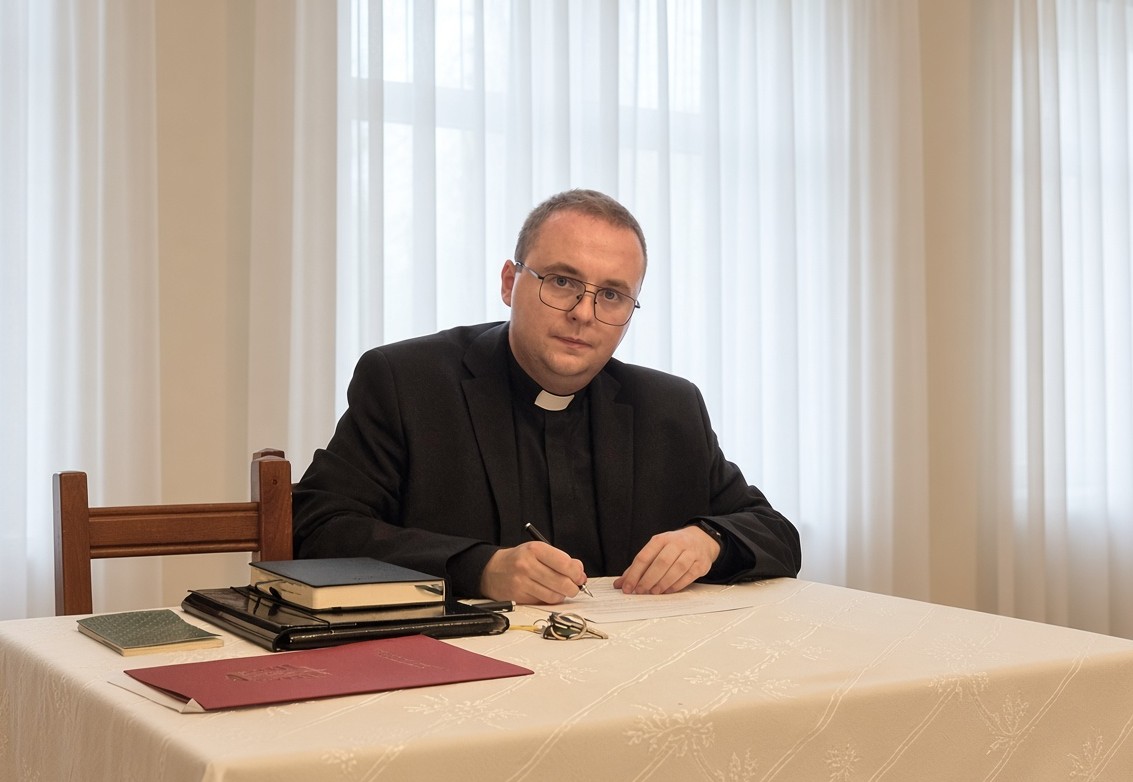

Tomorrow in Rome, the two‑day meeting of the Board of the John Paul II Vatican Foundation will begin. Meanwhile today, on 25 August 2026, on the eve of the gathering, a change took place in the position of Director of the Center for Documentation and Research of the Pontificate of John Paul II in Rome, operated by our Foundation. The Administrative Council of the John Paul II Vatican Foundation appointed Fr. Michał Grzesiak, a priest of the Archdiocese of Kraków, to this office. He succeeds Fr. Mirosław Cichoń, PhD.
The handover of the Centre to the new director took place at the institution’s headquarters at Via Cassia 1200 in Rome. In addition to Fr. Grzesiak and Fr. Cichoń, the meeting was attended by: Msgr. Paweł Ptasznik (Chairman of the Foundation), Msgr. Dariusz Giers (Administrator of the Foundation), Msgr. Jan Główczyk and attorney Filip Walis from the Foundation’s audit committee, as well as Fr. Tomasz Podlewski (Foundation spokesperson).
Visit the Centre’s website.
A Unique Institution in the World
The Center for Documentation and Research of the Pontificate of John Paul II in Rome is one of the institutions belonging to the John Paul II Vatican Foundation and at the same time one of the largest and oldest research centres in the world dedicated to the pontificate of the Polish Pope. Its mission is to document, promote, and develop the teaching and legacy of John Paul II. The institution was established by papal decree in the Vatican on 16 October 1981. It is located at Via Cassia 1200 in Rome.
Over nearly 45 years of activity, the Centre has prepared almost 50 book publications and dozens of academic and popular articles. It has also organised numerous conferences (including in Rome, Paris, Lugano, and Kraków), thematic meetings, and various exhibitions in Italy, Poland, and other countries. For several years, the Centre has also hosted one of the courses for students of “JP2 Studies,” organised at the Angelicum and supported by our scholarship programme.
The Centre consists of three departments: the archive, the library, and the museum. The archive preserves the writings of Karol Wojtyła from his episcopal period (1958–1978) and papal period (1978–2005), as well as audiovisual, photographic, and philatelic materials. The library contains an impressive collection of over 30,000 volumes in all European languages and several oriental ones. The museum houses gifts offered to the Pope during audiences, pilgrimages, and private meetings—around 20,000 artefacts from various fields of art. Its rich history, broad activity, extensive resources, international recognition, and above all its uninterrupted functioning for nearly half a century—initiated by John Paul II himself—make the Centre a unique institution in the world.
The New Director
From now on, this exceptional academic institution in the Eternal City will be led by Fr. Michał Grzesiak, historian and priest of the Archdiocese of Kraków. Fr. Grzesiak was born on 5 June 1995 in Kraków. He comes from the parish of the Sacred Heart of Jesus in Sułkowice. After graduating from the Bartłomiej Nowodworski High School in Kraków, he completed undergraduate studies at the Institute of History of the Pontifical University of John Paul II, earning a bachelor’s degree.
He then began formation at the Major Seminary of the Archdiocese of Kraków while simultaneously pursuing theological and philosophical studies at his Alma Mater. His master’s thesis in dogmatic theology was prepared under the supervision of Fr. Prof. Marek Gilski and Fr. Prof. Robert Woźniak.
He completed his diaconal internship at the parish of the Presentation of the Blessed Virgin Mary in Wadowice. After receiving priestly ordination on 25 May 2024 from Archbishop Marek Jędraszewski, he became vicar of the parish of St. Florian in Kraków. By decision of the current Metropolitan of Kraków, Cardinal Grzegorz Ryś, Fr. Grzesiak is now continuing specialised studies in Church history at the Pontifical University of the Holy Cross in Rome.
His academic interests concern the history of the Church in the 20th century, particularly the context of the pontificate of St. John Paul II. Additionally, the new director is interested in the history of Marian devotion, ecclesiastical heraldry, stained‑glass art, and wooden sacred architecture.
Fr. Grzesiak replaces Fr. Dr. Mirosław Cichoń, who will now be responsible for post‑academic pastoral ministry of the Archdiocese of Kraków at the Collegiate Church of St. Anne in Kraków.
A Personal Testimony of Fr. Michał Grzesiak
The newly appointed director shares:
I remember well May 2005 — I was ten years old. A month after the death of John Paul II, I travelled with my parents to Rome and visited the Polish House for the first time. In my childhood memory, I retained dozens of images and souvenirs offered to the Holy Father. Later came papal competitions and a passion for exploring the legacy of Karol Wojtyła: books, recordings, documentaries, pilgrimages near and far, and eventually a year in the basilica in Wadowice and a year at St. Florian’s in Kraków. Today, as a priest and historian — currently deepening my historical knowledge and qualifications — I can join this relay of memory, built over more than four decades of the Centre’s existence.
What comes next? Only God knows, but I entrust to His Providence the plans for the development of our institution. I would like the Centre always to remain a welcoming place for researchers and pilgrims, and for cooperation with other institutions safeguarding the memory of St. John Paul II to bear fruit in new academic projects and publications. Ahead of us lies the fiftieth anniversary of the John Paul II Vatican Foundation, and thus also half a century of our Centre. Then comes the year 2033 and the Jubilee of Redemption. Grateful to those who came before and thinking of those who will come after, I wish to contribute even a small brick by continuing existing projects and developing new ones. Our archival, library, and museum collections have great potential and can inspire many studies revealing the richness of the contexts of the pontificate of St. John Paul II.


