
Journalists called him the "Great Communicator". This was undoubtedly an enthusiastic and essentially accurate term. It rightly characterized the Missionary Pope, who preached the Good News on all continents. He did so in today's reality, in the specific situations of our time. And that's why he didn't side with the media, he used them often, but he never became a prisoner of them.
He didn't have any strategy. Karol Wojtyła was a truly authentic man. He was the Shepherd to evangelize. Does evangelization not mean "proclaiming the Good News"?
So, translated into today's language, does it not mean "communication"? From the beginning of his pontificate, John Paul II served a mission along the lines of the apostles. He preached, "communicated" everywhere the evangelical message. He was never relieved by the fear that the media would make his speech "unpopular."
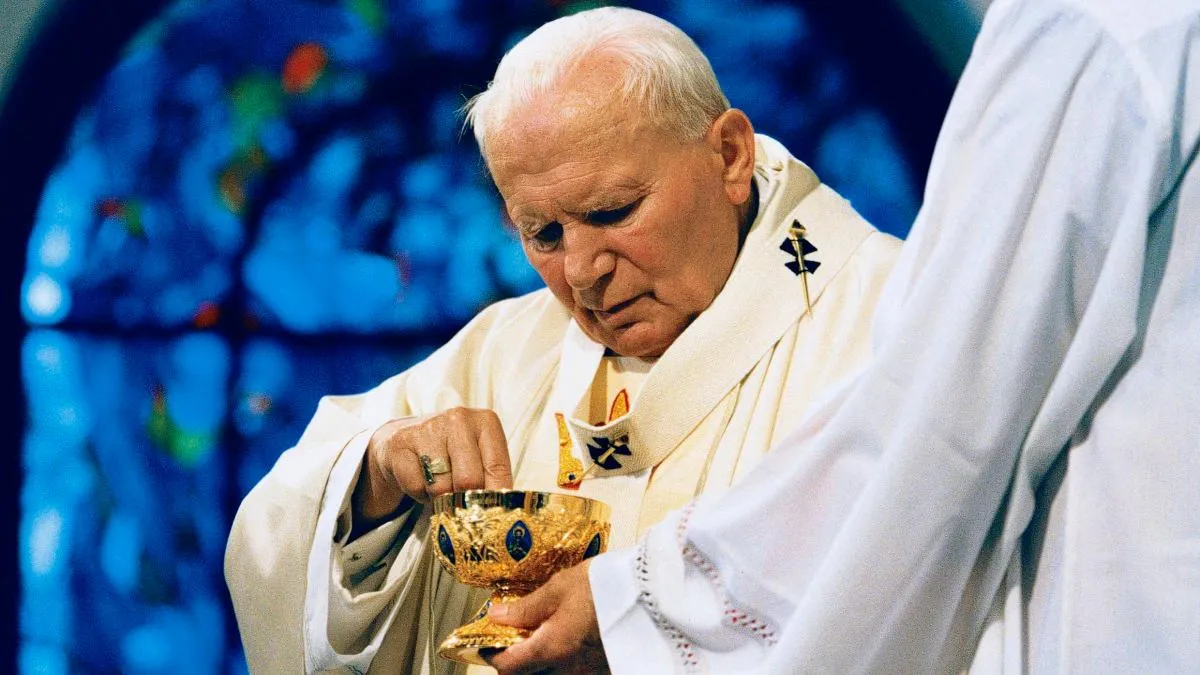
Marshall McLuhan argued, "The media is a message." The Pope reversed the importance of the problem: he used the media as a means, as a tool, never as a target. He learned the laws and principles of mass media, and therefore he was aware of the risks, but he never went with the flow, he never allowed to be used for spectacular purposes, for media purpose. Sometimes he seemed to do the opposite, as in the case of his second return from the Gemelli polyclinic, shortly before his death, when a live television transmission truck was driving behind when they were going to the Vatican. We have had to deal here with reckless action by third parties. The Holy Father merely acknowledged the presence of a television camera, although it was not desired by him. However, this was an exception that resulted from dramatic circumstances. I keep other images and stories in my memory. I recall how in Fatima the Holy Father prayed for a long time in front of the statue of our Lady. Or in Krakow, in the Wawel Cathedral for at least thirty minutes the Holy Father was deeply immersed in prayer in front of the tomb of St. Stanislaus. In both cases, television cameras were forced to humbly respect the Pope's "silence." They broadcast live images without movement, without sound, in complete silence. For such a long time, unimaginably long and valuable from a commercial point of view, they showed only a man in white, immersed in prayer. The Holy Father did not impose his "silence". He did only what he wanted internally at the time. And he wanted to pray.
With the consent of Cardinal Stanisław Dziwisz - "Testimony".
TBA marketing communication Publishing House. Warsaw 2007