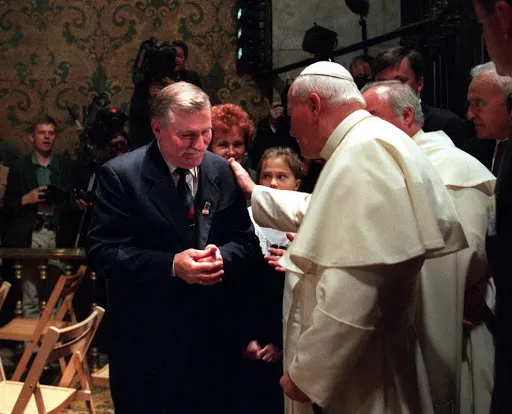

Lech Wałęsa was always saying that he goes to the Holy Father to recharge the batteries. He was coming often; first as president of Solidarity, then as president. Archbishop Mokrzycki was not present yet at these first audiences. He could not see with his own eyes the emotion and great joy of the meeting, when Polish freedom was born and then when it was already there. When John Paul II met the first prime minister of the free Poland Tadeusz Mazowiecki, the Archbishop did not see, but he heard, because the Pope himself was returning to it. The Holy Father regarded them as great heroes, as national leaders who could change Poland. He saw them as followers of Piłsudski. To the end he had great respect for Mazowiecki and, above all, for Wałęsa. Although we know that his story was different afterwards, there were attacks from different sides, but in the eyes of the Holy Father Lech Wałęsa remained a great man until the end. And, always the Holy Father had great respect for him.
- Then, others were coming: Aleksander Kwaśniewski, Leszek Miller ...
- And it was a very difficult situation for the Holy Father. The Holy Father has always followed the situation in Poland. He was up to date. And, when the President of the Communist Party was elected after Wałęsa, he was very troubled with it. It was a big blow for him.
- Did he feel disappointed by the Poles?
- He never said it, but it was visible. He was very troubled with it. I think that he felt disappointed. And then, when Aleksander Kwaśniewski, later Leszek Miller, came, he did not welcome them with great enthusiasm, with some particular joy. But, they were elected by the nation, in democratic elections. They ruled his homeland. He always took them with dignity and due respect. That's how I saw it, and that's how I felt.
With the permission of Archbishop Mieczysław Mokrzycki –“He liked Tuesdays the most”
M Publishing House, Krakow 2008