
As reported by Wojciech Rogacin from the Polish section of Vatican News:
“Over one hundred priests and crowds of Polish faithful gathered in St. Peter’s Basilica for the Holy Mass marking the 47th anniversary of the election of Karol Wojtyła as Pope. The congregation filled the space from the entrance to the Chapel of St. Sebastian, where St. John Paul II rests. Among the participants were members of the Maria Curie-Skłodowska University Choir from Lublin, who, after a 30-hour journey from Poland, joined the celebration, serving with their singing. Concelebrants included Cardinal Konrad Krajewski, Papal Almoner, Auxiliary Bishops of the Archdiocese of Katowice – Bishop Marek Szkudło, Bishop Adam Wodarczyk, Bishop Grzegorz Olszowski – as well as Bishop Radosław Orchowicz, Auxiliary Bishop of Gniezno. The Ambassador of Poland to the Holy See, Adam Kwiatkowski, was also present.”
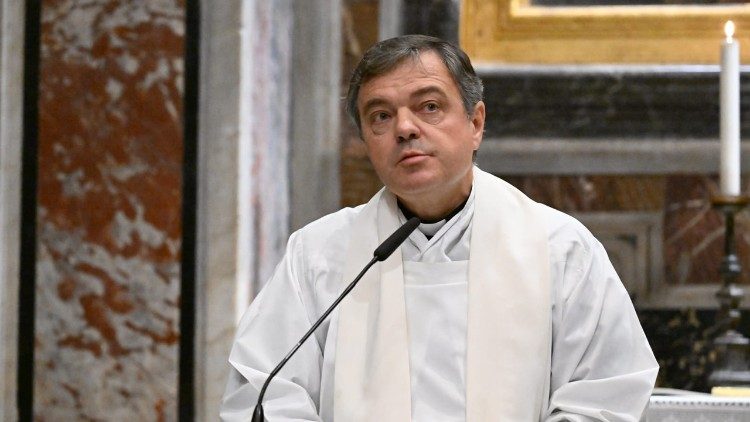
Homily by Fr. Arkadiusz Nocoń
Through the courtesy of Fr. Arkadiusz Nocoń, we publish the full text of his homily. From the Gospel of the Day (October 16, 2025)
“I will send them prophets and apostles; some of them they will kill and persecute.”
Whenever the Chosen People suffered oppression or turned away from God—neglecting His commandments and committing blasphemy—God sent them a prophet. With courage and truth, the prophet publicly rebuked the people and called them to conversion.
-
The prophet Nathan rebuked King David for adultery.
-
Jeremiah condemned the powerful for their injustice.
-
Micah denounced corrupt judges.
-
Amos spoke out against inhuman usury.
The prophets were the first defenders of the poor, heralds of justice, and awakeners of conscience.
The Prophet of Hope – Saint John Paul II
Forty-seven years ago, God sent to our nation a prophet of hope. At that time, we were surrounded by our own “Red Sea.” Scholars told us that communism would last forever, that nothing would change. We felt, as Dante wrote, “in hell—with no hope.”
That is why only those who lived through those days truly understand what the white smoke of October 16, 1978, meant, that Slavic name from the balcony (“Wojtyła”), the ringing of the Sigismund Bell over Kraków and all of Poland, the first televised Mass after decades of religious silence, and those pilgrimages of John Paul II when “Poland suddenly fell in love with Poland,” and people wrote on their banners:
“God is love, because He gave us you.”
We all warmed ourselves in his light. Since October 1978, no one has confused Poland with Holland or Poland with any other country.


